A pre-formed cap sleeve is not simply a smaller body label: it is a cut tubular piece designed to bridge a closure and bottle finish, with dimensions and shrink behaviour that determine whether it becomes reliable tamper evidence or a loose, distorted band. By checking the construction, measuring the actual pack, qualifying heat application, and comparing total line cost, you can decide whether the format suits your Kanpur operation.
Key takeaways
- Measure cap diameter, neck height, and tamper-break points before ordering.
- Use the lowest heat that shrinks the film without wrinkles or cap distortion.
- Reserve extra SKUs for products whose closure formats differ.
- Check tamper evidence, declarations, material layers, and recycling instructions before approval.
What exactly does a pre-formed cap shrink sleeve cover?
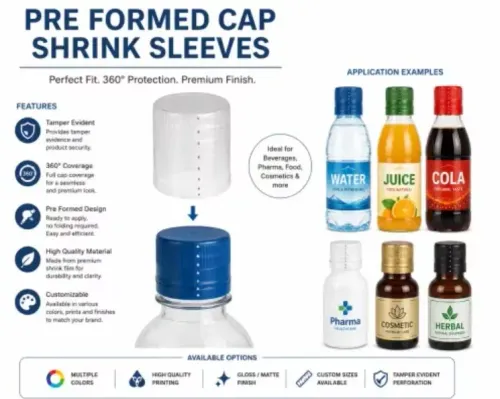
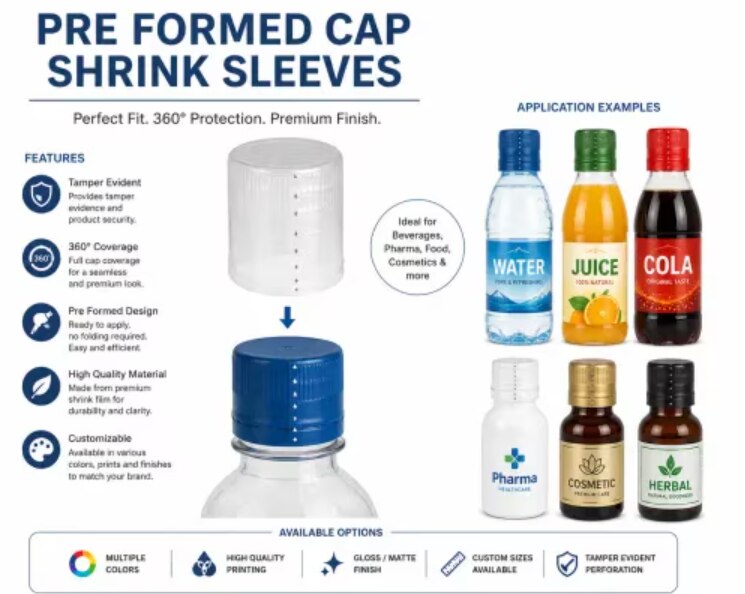
A pre formed cap shrink sleeve normally means an individually cut, tubular sleeve supplied in finished lengths for the cap and neck area. It is an outer tamper-evident band, not automatically a cap seal, bottle sleeve, or combined neck-and-body construction.
Unlike a roll-fed body shrink sleeve, which is cut and seamed around the container on the line, the preformed sleeve arrives already shaped. The operator positions it over the cap and neck finish before heat is applied.
Its coverage can include the cap top, cap skirt, neck finish, tamper area, or the complete upper closure. The critical point is the lower edge: it must bridge the cap and container finish.
A sleeve gripping only the cap can rotate or lift without clearly showing opening; one extending too far down can wrinkle, bridge, or interfere with the shoulder.
- Place the individual sleeve over the closure and neck.
- Align the tear strip, vertical perforation, or easy-open tab with the intended front or back position.
- Apply controlled heat in a tunnel or use steam so the sleeve contracts around both surfaces.
- Cool and inspect for even contact, a clean break pattern, and no lifted edge or shoulder wrinkle.
Cap shrink sleeves Kanpur buyers should not confuse this outer feature with an induction wad, foil membrane, or other internal product seal. Compared with a full-body shrink label, it provides a narrow, visible tamper feature but far less printable surface.
How do you measure the bottle and apply the sleeve correctly?
Measure the closure and neck finish separately, then specify the final sleeve dimensions; bottle volume alone cannot predict fit. A buying brief for pre formed cap shrink for sleeves kanpur should record:
- Cap outside diameter, cap height, neck-finish diameter, shoulder profile, cap-skirt height, and thread or lug geometry.
- Clearance around pumps, flip-tops, spouts, and tamper-evident features.
- Sleeve length, diameter, shrink direction, overlap across the cap and finish, and allowable bottle and closure variation.
Do not approve a quote that omits these fields. Two sleeves with the same nominal diameter can behave differently when cap tolerances or shoulder angles change.
Apply each sleeve in this order:
- Place the individual tubular sleeve over the closure, covering the required cap and neck area.
- Align the tear strip or easy-open tab with its specified front or back position.
- Pass the pack through the heat tunnel or steam applicator at the trial settings.
- Cool the pack before judging the final band.
- Inspect even contact, no bridge over the shoulder, no lifted edge, readable print, an intact break pattern, and unchanged cap alignment.
Run the trial with the actual bottle, cap, closure torque, sleeve, applicator, and line speed. This sequence gives shrink sleeves kanpur teams a defensible specification instead of relying on a catalogue sample.
Which film and heat settings prevent distortion?
A quoted shrink percentage does not qualify a cap sleeve. Select the film with a trial that records film type, gauge, shrink direction, shrink range, tunnel temperature, dwell time, conveyor speed, airflow or steam distribution, and cap material.
| Film | Shrink temperature | Transverse force and stiffness | Appearance | Recycling consequence |
|---|---|---|---|---|
| PVC | Low to moderate; commonly processed around 70–90°C | Moderate force, flexible | Clear, glossy | Can contaminate PET recycling streams |
| PETG | Moderate; commonly around 70–100°C | High force, stiff | Very clear, glossy | Dense sleeve material can hinder PET flake separation |
| OPS | Moderate to high; commonly around 80–110°C | Lower force, relatively stiff | Clear, crisp | Check compatibility with the bottle’s recycling route |
| Polyolefin | Moderate to high; commonly around 90–140°C | Balanced force, flexible | Clear or printed with good toughness | Confirm density, coverage, and recycler acceptance |
Transverse shrink force matters most at the cap. Excessive force can distort a light cap, increase opening torque, or pull the closure out of alignment; insufficient force leaves loose zones and weak tamper evidence.
Record perforated tear strips, vertical perforations, easy-open tabs, and break patterns in the approval sample. Test them after shrinking, repeated opening, warehouse heat exposure, and vibration. For shrink labels Kanpur distribution, accelerate heat exposure first, then run filled-pack transport trials: heat can relax film, soften inks or adhesives, and expose weak cap contact.
Apply the same qualification to cap shrink sleeves Kanpur plants buy, rather than selecting on quoted shrink percentage alone.
When does the format justify its extra SKU handling?
It justifies the extra SKU handling when a narrow, high-visibility tamper band matters more than full-container graphics, and bottle and closure geometry stay stable. Pre-formed sleeves remove in-line tube cutting and seaming, simplifying application and improving band consistency.
The cost is finished-SKU control: each cap diameter, colour, graphic, pack count, or closure supplier can require separately identified stock.
| Option | Applied cost and rejects | Speed, changeover and storage | Best use |
|---|---|---|---|
| Pre-formed cap sleeve | Simple application can reduce rejects caused by cutting or seams; include sleeve, labour and scrap in the applied cost | Faster changes only when the correct finished sleeve is ready; more cartons, space and minimum-order exposure | Stable geometry, narrow tamper bands, limited graphics |
| Roll-fed shrink label | Less pre-cut inventory, but cutting, seaming and alignment affect reject cost | Better for high throughput or frequent geometry changes; fewer finished sleeve SKUs | Full-body graphics and changing pack formats |
Ask the supplier to quote and record:
- Film type and gauge, sleeve diameter and length, shrink direction and range
- Print and coating resistance, packing or core format, splice and defect limits
- Application temperature window and the approved bottle-and-cap drawing
- Minimum order by finished SKU and the expected storage footprint
Run both formats on the intended applicator using production speed, closure torque and actual packs. That trial matters more than film price alone. For a buyer searching pre formed cap shrink for sleeves kanpur or shrink labels kanpur, Crystal Vision Packaging Co can help translate the drawing into printed samples and a production trial.
Related product
 | Pre Formed Cap Shrink Sleeves Pre Formed Cap Shrink Sleeves In Nagpur ₹2 Pre-Formed Cap Shrink Sleeves in Nagpur | Crystal Vision Packaging Co Looking for high-quality Pre-Formed Cap Shrink Sleeves in Nagpur, Wardha, and... |
What compliance and end-of-life checks complete the decision?
Mechanical performance is only half the approval. For food, beverage, cosmetic, and pharmaceutical packs, request a documented assessment for the exact film, inks, coatings, adhesives, and contact conditions.
For food, ask for documentation against the Food Safety and Standards (Packaging) Regulations, 2018, plus migration or safety test results; “food grade” alone is not evidence of compliance.
| Material | End-of-life concern | Check before claiming recyclability |
|---|---|---|
| PVC | Can disrupt PET recycling | Ask the intended recycler |
| PETG | Density can hinder PET flake separation | Confirm sorting guidance |
| OPS | Density, inks, and coverage can affect separation | Obtain bottle-and-sleeve guidance |
| Polyolefin | Compatibility depends on the recycling stream | Verify local recycler instructions |
For shrink sleeves Kanpur plants should test actual warehouse and transport exposure: heat can relax film, soften inks or adhesives, and weaken cap contact. Shrink labels Kanpur brands call recyclable must be assessed as the complete bottle-and-sleeve combination, not the bottle alone.
Approve only after these tests pass:
- Dimensional and heat trials on production equipment
- Opening, storage, and filled-pack distribution tests
- Clean opening, stable tamper evidence, and acceptable print and adhesive performance
Choose pre-formed cap shrink when tamper visibility, application consistency, and simpler line operation outweigh SKU inventory and material constraints. Reject it when closure dimensions fluctuate beyond validated tolerance, the sleeve cannot open cleanly, or the brand needs extensive body graphics.
Frequently asked questions
What does a pre-formed cap shrink sleeve cover?
It covers the cap and adjacent neck area as an outer tamper-evident band. It is not automatically a cap seal, bottle sleeve, or combined neck-and-body sleeve.
How do you measure a bottle for a pre-formed cap shrink sleeve?
Measure the cap’s outside diameter, the required sleeve height, the neck profile, and the position of any tamper-break feature. Confirm measurements on production samples.
Which film and heat settings help prevent shrink-sleeve distortion?
Match the film’s shrink direction and shrink range to the cap geometry. Start with the lowest tunnel or heat-gun setting that produces a tight, even fit, then check wrinkles, lifting, and cap deformation.
When are pre-formed cap shrink sleeves worth the extra SKU handling?
They make sense when closure tamper evidence, a clean cap finish, or a separate neck format justifies storing and applying another component. Avoid them when one standard seal or body sleeve meets the requirement.
What compliance and end-of-life checks should you complete?
Confirm tamper-evidence performance, artwork and traceability details, material declarations, adhesive or ink information, and disposal guidance. Check whether the sleeve must be removed before recycling the bottle.