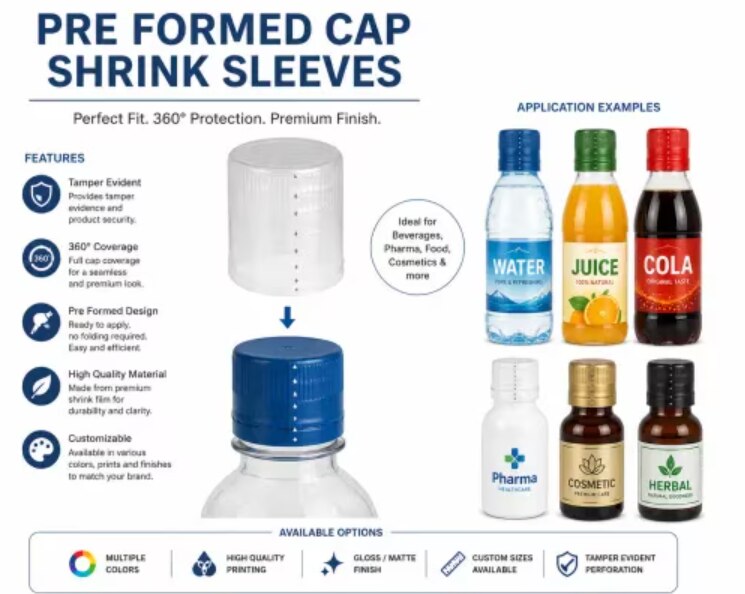
A cap sleeve must fit the assembled closure, survive the heat tunnel, and show the intended level of tamper evidence; a decorative tube alone does not guarantee any of these results. By the end, you will have a measurement checklist, material-selection method, application settings to confirm, and a procurement specification suited to industrial packs delivered into Sikkim.
Key takeaways
- Measure the assembled cap-and-neck circumference, not the nominal cap diameter.
- Keep tamper evidence separate from decoration and validate the heat-shrink process.
- Choose sleeve film by chemical exposure, temperature, abrasion, and transport conditions.
- Put dimensions, material, artwork, testing, and delivery requirements in one purchase specification.
Specify the sleeve from the assembled pack, not the cap diameter
The deciding measurement is the maximum outside circumference of the assembled cap-and-neck, not the nominal cap diameter. Measure the closure bead, tamper ring, shoulder transition, and any handle or trigger on the actual filled pack; these features determine whether the sleeve clears the opening and shrinks without tearing.
1. Record the cap diameter, neck diameter, maximum assembled circumference, and the height from the cap top to the container shoulder. Include the widest point created by a trigger, handle, rib, or dispensing head.
2. Specify the finished sleeve height and the required overlap onto both closure and container. State the top and bottom opening dimensions, or the layflat and finished diameter, rather than giving only a nominal cap size.
3. Describe the construction: individual pre-formed tube or cap, film substrate, seam position, seam width, print orientation, and whether the sleeve has a tear band, vertical perforation, horizontal perforation, or another controlled opening feature.
4. State the intended function separately: decoration, dust protection, tamper evidence, or a combination. A printed sleeve that contracts around the cap does not prove first opening; the perforated band must interfere with closure removal and break or visibly distort.
5. Approve a production trial on the assembled pack through the intended hot-air or steam process. Check fit, wrinkles, tearing, artwork alignment, sleeve removal, and retained overlap. ASTM D2732 can compare film shrinkage, but it cannot replace this finished-pack trial.
For pre formed cap shrink sleeves for Sikkim, provide pack drawings, tolerances, material, colour, artwork, perforation pattern, and test samples. Keep “Sikkim” in the specification and verify Legal Metrology declarations when the sleeve carries retail-pack information.
Separate tamper evidence from decoration and control the heat process
A cap sleeve proves tamper evidence only when opening the closure breaks or visibly distorts it. A sleeve that merely contracts around a cap provides decoration, dust protection, or branding; it does not prove that the pack was unopened.
For cap shrink sleeves in Sikkim, define the tamper feature separately from the artwork. Specify a perforated tear line, frangible band, or bridge that crosses the cap-to-neck opening and cannot be pulled off intact. The band must interfere with closure removal, not simply sit on the cap.
1. Confirm the sleeve orientation against the printed artwork, seam, tear line, and closure features before loading the applicator.
2. Place the sleeve over the cap and neck until its lower edge reaches the specified container position. Check that it bridges the closure bead, tamper ring, and shoulder without covering a trigger or handle.
3. Run the pack through the validated steam tunnel or hot-air tunnel. Control tunnel temperature, zone settings, conveyor speed, and dwell time; excessive heat wrinkles or tears the band, while insufficient heat leaves gaps and allows removal.
4. Inspect the first packs and repeat the check after line changes, film-lot changes, or tunnel adjustments. Record the settings with the batch.
Open finished packs by the normal closure action. The tear line or band must break visibly, and the sleeve must not slide off as one intact piece. ASTM D2732 can compare film shrinkage between lots, but only a trial on the assembled pack proves fit and tamper function.
Choose PVC, PET-G, OPS, or polyolefin against the operating environment
A shrink film Sikkim request is incomplete without the polymer and gauge. Choose against the contents, handling route, recovery system, and temperature range—not print appearance alone. Test the finished sleeve for chemical contact, oil or solvent exposure, abrasion, stacking, ultraviolet exposure, and temperature cycling.
| Option | Best fit | Watch-out |
|---|---|---|
| PVC | Clear, printable sleeves with moderate shrink, often around 40–60% | Chlorinated material can complicate recycling, and PET-bottle recovery streams may retain it with PET flakes |
| PETG | High shrink, often up to roughly 70–80%, for contoured caps and strong graphics | Dense PETG can contaminate PET flakes; confirm the recycling pathway before specifying it |
| OPS | High shrink, often around 60–70%, with stiffness and clean appearance | Check low-temperature handling; OPS can become brittle, and its shrink response is grade-specific |
| Polyolefin | Moisture, chemicals, oils, and recycling designs that depend on float-sink separation | Confirm the exact grade’s shrink force, clarity, print adhesion, and tunnel temperature |
Temperature changes expose weak choices quickly. A sleeve that shrinks neatly in a hot-air tunnel can crack during cold storage, distort in a hot vehicle, or lose ink through abrasion. Run a directional shrink test on the actual cap, then cycle sealed packs through the lowest and highest expected temperatures.
For food-containing packs, verify the film, inks, coatings, adhesives, and cap materials against the applicable Food Safety and Standards Authority of India packaging requirements. A general industrial declaration does not prove food-contact compliance.
Compare cap sleeves with other identification and labeling formats
Choose a pre-formed cap sleeve when the assembled closure has an irregular cap-and-neck shape, needs a visible opening cue, or cannot accept a flat label without wrinkles. It arrives as an individual tube or cap, so it fits the three-dimensional closure rather than forcing roll material around it.
| Option | Strength | Choose it when |
|---|---|---|
| Pre-formed cap sleeve | Bridges cap and neck; can include a perforated tear band | You need tamper evidence, dust coverage, or decoration on a trigger, handle, shoulder, or uneven closure |
| Flat roll film | Continuous material for forming body labels | You run a high-speed roll-fed labeler on consistent cylindrical packs; it is inefficient for individual cap geometry |
| Pressure-sensitive label | Adhesive-backed label applied without heat | You need variable data, quick format changes, or application after filling; it is a poor choice when moisture, abrasion, or closure interference can lift the label |
| BOPP wrap-around label | Tough, economical body label for cylindrical containers | You need 360-degree branding on a straight container body, not a cap-and-neck seal or opening indicator |
| In-mould label | Label fused into the container during moulding | You control the container mould and want a highly durable finish; it is unsuitable for retrofitting existing packs |
Do not select a cap sleeve for identification alone if a simple pressure-sensitive label solves the job. For shrink sleeves sikkim purchasing, specify the cap sleeve when first-opening evidence matters: the perforations or tear band must break when the closure is removed, rather than merely contracting around it.
Build a Sikkim purchase specification that survives application and transport
A Sikkim purchase order must define the assembled pack and the delivery risk, not just the film grade. Record maximum cap-and-neck circumference, closure bead, tamper ring, shoulder transition, sleeve height, layflat, top and bottom openings, seam position, perforation pattern, and overlap onto the cap and neck.
A dimensional trial must confirm fit after shrinking on the actual pack.
Ask the supplier for:
- A signed drawing showing seam, front-panel datum, tear-strip position, print orientation, and registration tolerance.
- Trial samples run through your steam or hot-air tunnel, with checks for bridging, tearing, wrinkles, cap interference, and visible first-opening evidence.
- Film thickness, substrate, shrink-temperature range, ink and adhesive details, carton quantity, batch number, and inspection results.
- Transport packing that prevents crushing, moisture entry, telescoping, and heat deformation; inspect cartons on arrival before releasing them to production.
- A replenishment plan covering production lead time plus a monsoon and hill-road delay buffer, rather than ordering only against the next dispatch.
- Written confirmation of the responsible producer, importer, or brand owner for India’s Plastic Waste Management Rules, plastic-packaging category, EPR registration, reporting, and recycling duties.
For cap shrink sleeves Sikkim procurement, test cartons after simulated stacking and a realistic handling journey. Keep the specification, approved sample, artwork proof, and batch records together.
Crystal Vision Packaging Co can use those records to quote pre formed cap shrink for sleeves sikkim accurately, while your team evaluates shrink film Sikkim requirements against application and transport conditions.
Related products
 | Pre Formed Cap Shrink Sleeves Pre Formed Cap Shrink Sleeves In Nagpur ₹2 Pre-Formed Cap Shrink Sleeves in Nagpur | Crystal Vision Packaging Co Looking for high-quality Pre-Formed Cap Shrink Sleeves in Nagpur, Wardha, and... |
 | PET Shrink Labels PVC / PET-G Shrink Sleeves in Nagpur PVC Shrink Labels are flexible plastic labels made from Polyvinyl Chloride (PVC) that shrink tightly around a product when heat is applied. View product → |
Frequently asked questions
How should you specify a pre-formed cap shrink sleeve?
Measure the maximum outside circumference of the assembled filled pack, including the closure bead, tamper ring, shoulder transition, and any handle or trigger. Specify the sleeve’s finished dimensions against that measurement rather than relying on cap diameter.
How do tamper evidence and decoration differ on a cap sleeve?
Tamper evidence must show whether the closure has been disturbed; decoration only identifies or promotes the product. Define the evidence feature separately, then control the sleeve’s heat exposure so it shrinks evenly without tearing, lifting, or distorting the artwork.
How do you choose between PVC, PET-G, OPS, and polyolefin shrink film?
Compare each film with the pack’s operating environment: chemical contact, temperature, moisture, abrasion, storage, and transport. Select the material that remains stable through filling, application, handling, and distribution.
What should a Sikkim purchase specification include?
Include the assembled-pack measurements, sleeve dimensions, film type, tamper-evidence requirement, artwork, application temperature and equipment conditions, inspection criteria, packing method, and transport requirements.