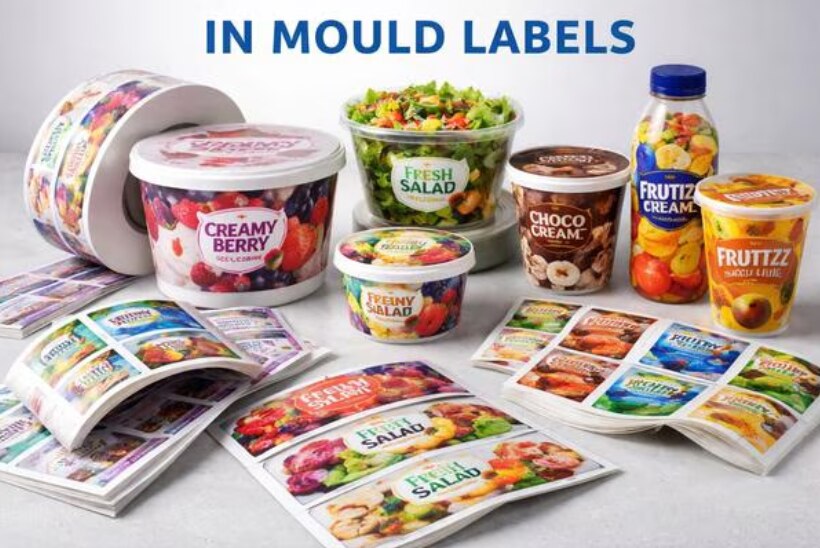
A pharmaceutical pack with an in-mould label combines container forming, decoration, coding, and inspection in a tightly controlled sequence. By the end, you will know which pack types suit the process, what to specify, how to protect scan reliability, and how to compare suppliers in Kanpur.
Key takeaways
- Load the pre-printed insert against the mould cavity before plastic injection or blowing.
- Match IML to rigid containers made by injection moulding, blow moulding, or thermoforming.
- Specify substrate, artwork tolerances, barcode grade, adhesive needs, and moulding conditions.
- Check label placement, scuff resistance, batch coding, and barcode readability before production.
What happens during pharmaceutical in-mould labelling
The container is decorated inside the mould, not labelled after it is made. A pre-printed insert is loaded into the tool, picked by vacuum ports or held by electrostatic charge, and positioned against the cavity wall.
Polypropylene or polyethylene then surrounds the insert during injection or blow moulding, bonding the substrate to the container as pressure, heat, and cooling create the finished pack.
- Load the inserts and verify artwork orientation, because poor stacking can cause rotation or incomplete transfer.
- Position each insert; shifting, wrinkles, and trapped air begin when vacuum-hole coverage or electrostatic charge is uneven.
- Inject molten resin or inflate a parison around the insert. Incorrect label stiffness, wall movement, or temperature can cause distortion, print damage, or delamination.
- Cool the moulded container, eject it, and check registration, colour, surface defects, and label adhesion.
- Use camera inspection to reject missing, shifted, damaged, or unreadable packs, then segregate them.
- Pack accepted containers only after documented line clearance confirms removal of previous product, labels, inserts, and waste.
| Process | Main control | Typical risk |
|---|---|---|
| Injection IML | Insert fixed in a rigid cavity | Shifting or trapped air |
| Blow IML | Insert follows an inflating parison | Stretching and artwork distortion |
In mould labels provide decoration and identification only. They do not provide tamper evidence, child resistance, sterility, moisture protection, or light protection; pharmaceutical labels Kanpur buyers specify still need a closure, liner, induction seal, overcap, or separate security feature.
Which pharmaceutical packs and moulding methods suit IML
IML suits rigid tablet bottles, syrup bottles, ointment jars, diagnostic containers, medical-device packs, and selected closures when their shape remains stable. It is a poor fit for blister cavities, aluminium foil lidding, flexible sachets, and packs needing frequent late-stage artwork changes.
| Pack format | IML suitability | Main limitation |
|---|---|---|
| Rigid PP or HDPE bottle | High | Needs compatible label film and stable geometry |
| Jar or tub | High | Deep recesses and sharp shoulders complicate transfer |
| Selected closure | Moderate to high | Small radii and moving interfaces restrict artwork |
| Blister or foil-lidded pack | Low | Uses forming foil, lidding foil, paperboard, or separate labels |
| Flexible sachet | Low | Film flexing prevents reliable moulded decoration |
| Sterile pack | Conditional | Requires validated barrier and aseptic controls beyond decoration |
Injection-moulded IML places a flat label inside the cavity before molten polymer enters. It works best on broad, flat or gently curved PP and HDPE surfaces, including bottles, jars, tubs, and some closures; deep recesses, handles, sharp shoulders, and steep tapers create wrinkles, trapped air, or incomplete bonding.
Blow-moulded IML follows a parison or preform during inflation. Control label placement, stretching, wall thickness, and artwork distortion, especially around shoulders and tapered bodies.
In mould labels become part of the container, not its sterile barrier or tamper evidence. A search for in mould labels for kanpur should therefore compare decoration with validated sterile-pack systems, not treat appearance as proof of pharmaceutical suitability.
How to write an IML specification for a pharmaceutical pack
Start with the container drawing, not the artwork file. A specification for pharmaceutical labels Kanpur procurement should identify the resin, such as polypropylene or HDPE, and define the label film, thickness, length, height, radius, corner shape, position, orientation, print side, surface finish, and colour references.
1. State whether the label sits outside the container, contacts the product, or is trapped between polymer layers. Direct contact changes the required substrate, ink, coating, migration evidence, and compatibility testing; a protected printed layer does not remove the need to identify every material.
2. Attach the approved artwork revision and define print-registration tolerance, label-to-container registration, minimum readable text size, barcode or 2D-code grade, and permitted cosmetic defects. Identify the substrate and request ink and coating declarations.
3. Include product name, composition where required, manufacturer details, batch number, manufacturing date, expiry date, storage directions, and wording required for Schedule H, H1, or X medicines. Permanent moulded decoration does not exempt the pack from Indian drug-labelling rules.
4. Define change control for artwork, resin, film, ink, coating, tooling, and process settings. Ask for traceability, line-clearance records, foreign-matter controls, inspection records, and conformity documents.
5. Verify any ISO 15378 claim for the actual site, material, and process. ISO 9001 alone proves none of those points. This discipline makes packaging labels Kanpur purchasing a controlled component decision, not a visual print order.
How batch data, barcodes, and QR codes remain readable
Print lot-specific data after moulding: batch number, manufacturing and expiry dates, serialisation, and aggregation data change by run. Licence details, dosage instructions, and storage conditions belong in approved artwork when fixed, but a controlled variable IML insert can carry them. Otherwise use inkjet, laser, thermal-transfer, or another qualified coder on the finished pack.
| Option | Best use | Control |
|---|---|---|
| Pre-printed IML | Fixed artwork | Approved revision and print tolerance |
| Post-mould coding | Batch and serial data | Validated coder and readable impression |
| Variable IML insert | Changing artwork or data | Approved, traceable insert system |
Agree GS1 Application Identifiers, GTIN requirements, and the applicable Indian product-identification scheme through GS1 India or the responsible customer before artwork release. For in mould labels for Kanpur, specify quiet zones, dark-on-light contrast, minimum module size, orientation, and curvature limits. Varnish glare and blow-moulding stretch can distort codes.
- Request a barcode-verification report or defined grade, not only a visual proof.
- Verify on the finished curved container after moulding, coding, varnishing, and other treatment.
- Segregate rejected packs through documented line clearance and inspection records.
That evidence matters when qualifying pharmaceutical labels in Kanpur, because a clean-looking code can still fail scanning.
How to prevent IML defects before pharmaceutical production
Approve the first article before releasing pharmaceutical production. Match label stiffness and thickness to the mould cavity; an unsuitable substrate causes shifting, rotation, wrinkles, trapped air, poor registration, or incomplete transfer. Confirm vacuum-hole layout or electrostatic charge holds the insert flat.
- Record mould temperature, injection or blowing pressure, cooling time, and ejection force; excessive heat distorts containers, while early ejection causes warpage or label lift.
- Inspect the label-polymer interface for scuffing, delamination, and edge lift.
- Check container-to-label registration, small-text legibility, and barcode performance on finished containers.
- Compare colour with an approved physical standard, not a screen proof.
- Set acceptance limits using signed samples and photographs for cosmetic defects.
- Control foreign matter, approved artwork revision, raw-material lot traceability, line clearance, and certificate-of-analysis or conformity records.
| Control point | First-article check | Production check |
|---|---|---|
| Registration | Measure label position against the drawing | Sample containers at defined intervals |
| Print and text | Approve colour standard and minimum text size | Inspect colour, clarity, and rotation |
| Code | Verify barcode grade after moulding | Segregate failures and record results |
For in mould labels, document whether ink faces the product, sits outside, or is trapped between polymer layers. Packaging labels Kanpur buyers should require complaint investigation, change control, and supplier notification before material, artwork, ink, coating, mould, or process changes. A clean appearance alone does not establish GMP suitability for a primary packaging component.
How Kanpur buyers should compare an IML supplier and total pack cost
Compare the delivered pack, not the IML insert price. IML suits stable, high-volume SKUs, but pressure-sensitive labels or shrink sleeves often win for short runs, frequent artwork revisions, multiple language versions, late-stage coding, or changing pack sizes.
| Option | Cost advantages | Cost risks |
|---|---|---|
| IML | No later label application; durable decoration | Mould changes, tooling, minimum order quantities, insert waste, start-up scrap, and separate coding or inspection equipment |
| Pressure-sensitive label | Flexible artwork changes, short runs, multiple languages, and late coding | Application equipment, adhesive control, liner waste, and possible lifting or scuffing |
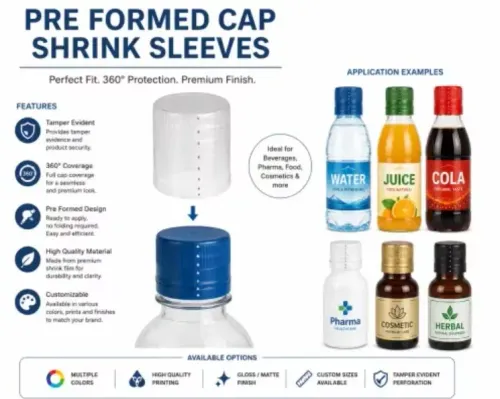
| Shrink sleeve or other method | Full coverage and version flexibility | Heat-shrink equipment, material waste, sleeve registration, and extra inspection |
Compare the container, closure, liner or seal, label, mould modification, tooling, coding, inspection, validation evidence, approved samples, and artwork-change cost. Ask Crystal Vision Packaging Co for material declarations, process-capability evidence, first-article samples, barcode verification, batch traceability, defect limits, and the manufacturing site’s actual quality-management scope, including ISO 15378 coverage where claimed.
For in mould labels for Kanpur, use this checklist; it makes packaging labels Kanpur procurement a controlled pack decision, not a per-label quotation.
Related product
 | In-Mould Labels In-Mould Labels (IML) are pre-printed labels that are placed inside a mould before the plastic injection or blow moulding process. View product → |
Frequently asked questions
How do in-mould labels work on pharmaceutical containers?
A pre-printed insert is placed inside the mould and held against the cavity wall by vacuum ports or electrostatic charge. Plastic then forms around the insert, integrating the decoration with the container surface.
Which pharmaceutical packs suit in-mould labelling?
Rigid bottles, jars, tubs, and other containers made by injection moulding, blow moulding, or thermoforming can suit IML when the insert, mould geometry, and production process are compatible.
What should a pharmaceutical IML specification include?
Define the container resin, moulding method, label dimensions, substrate, artwork, colour requirements, placement tolerance, surface finish, batch-code area, barcode or QR-code size, and inspection criteria.
How can you keep pharmaceutical barcodes and QR codes readable?
Reserve a flat, high-contrast coding area, control artwork distortion during moulding, keep codes clear of seams and curves, and verify printed codes after production with a barcode verifier or scanner.
Keywords