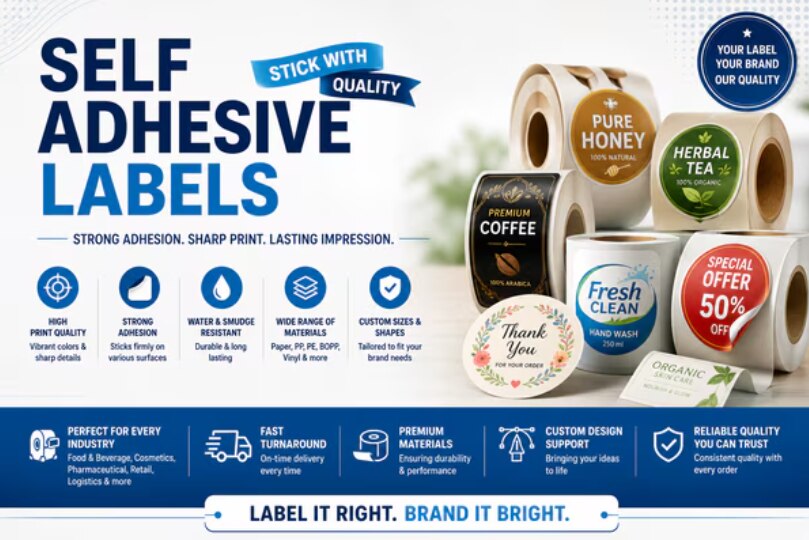
A label that looks correct on screen can still fail on a damp bottle, a chilled container, or a fast-moving packaging line. You will learn how the label web is converted, how to match materials and adhesives to Assam conditions, and how to specify and test rolls before approving production.
Key takeaways
- Specify face material and adhesive for Assam’s heat and humidity.
- Test adhesion on the actual bottle, container, and finished pack.
- Match label dimensions and winding direction to the application machine.
- Provide artwork, materials, tolerances, and roll details in the production specification.
From artwork file to finished label roll
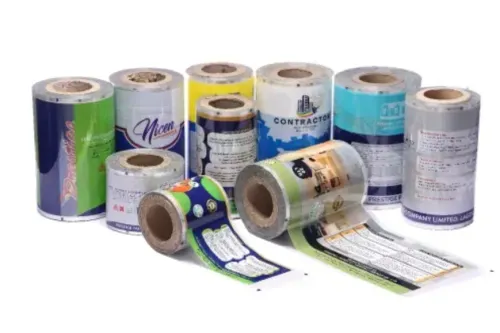
Artwork becomes self adhesive labels through a controlled web process, not by cutting individual stickers from a printed sheet. The converter normally prints the web first, then applies finishing, die-cuts the labels, removes waste, slits the web, and rewinds it.
1. Prepress checks the label dimensions, bleed, dieline, safe area, barcode size and contrast, colour references such as Pantone numbers, and variable data such as batch codes or serial numbers. The approved proof must match the container and applicator direction.
2. The converter selects coated or uncoated paper, BOPP, PET, or PE labelstock for the required moisture, scuff, flexibility, opacity, and chemical resistance. Adhesive is either coated onto the chosen face material and dried or cured, or purchased as pre-coated stock with a release liner.
3. Printing uses flexography, offset, screen, digital inkjet, or electrophotography. Run length, setup cost, substrate, colour demands, drying or curing needs, and variable data determine the choice.
4. Varnish or laminate adds abrasion, moisture, or chemical protection. Excess coating or poor curing can change barcode contrast, roll release, die-cutting, adhesive performance, and later dispensing.
5. A rotary die cuts the face and adhesive without cutting the liner. The operator adjusts depth: too deep damages dispensing and encourages adhesive ooze; too shallow leaves labels in the matrix.
6. Matrix stripping removes the waste lattice, then inspection checks registration, missing labels, print defects, splice placement, and clean roll edges.
7. Slitting and rewinding produce the specified roll width and tension. Uneven tension creates telescoping, wrinkles, blocking, or poor application, so every finished roll is checked before dispatch.
Each coating and curing stage affects how labels release and dispense on the packaging line.
Choosing face material and adhesive for Assam conditions
For self adhesive labels for Assam, choose the construction from the pack and exposure, not the product category. A dry glass test proves little: damp HDPE has lower surface energy, mould-release residue, curvature, and condensation, so even permanent adhesive can lift. Record application temperature, service temperature, curvature, line speed, and wipe pressure.
| Face stock | Strengths | Limits and suitable use |
|---|---|---|
| Coated paper | Opaque, smooth, sharp print, economical | Poorer moisture and scuff resistance; dry cartons and indoor packs |
| Uncoated paper | Natural appearance, high opacity, low cost | Absorbs water and dirt; dry corrugated cartons |
| BOPP | Moisture and scuff resistance, flexible, white or clear | Less conformable than PE; bottles and chilled packs |
| PET | High chemical, heat, and abrasion resistance; dimensionally stable | Low stretch and higher cost; demanding packs |
| PE and other films | Soft, conformable, stretchable, good on curved or squeezable packs | Lower stiffness and print opacity unless engineered |
- Permanent suits clean glass, PET, PP, metal, and HDPE when removal is not required.
- Removable or repositionable suits temporary identification and selected cartons; textured surfaces need a high-tack construction.
- Freezer-grade suits refrigerated containers, where condensation and low application temperature defeat ordinary adhesive.
- Corrugated cartons need an adhesive matched to dust and fibre; test dusty storage before ordering.
During Assam monsoon humidity, protect rolls from direct sunlight, uncontrolled humidity, dust, and rapid temperature changes. Store them within the labelstock supplier’s technical data sheet limits; humidity can curl paper, change dimensions, weaken edges, and cause transfer or poor die-cutting. Heat during transport and temperature swings require testing before chilling or filling.
That is why adhesive labels assam need pack-specific trials.
Testing adhesion, durability, and finished-pack performance
Prove the label on the actual container, not on a smooth laboratory panel. Apply it to the production finish at the intended line speed and wipe-down pressure, including a cold container with condensation if that matches use.
Inspect after 24 and 72 hours for peel, edge lift, bubbling, wrinkling, sliding, and curl; then expose samples to water and rubbing.
A test for sticker labels Assam packaging should include the real time between labelling and chilling or filling. Record peel adhesion separately from loop tack and shear: ASTM D3330 is a reference method for peel adhesion, loop tack measures initial grab, and ASTM D3654 measures shear or holding power against sliding and creep.
High tack does not prove long-term peel strength, and a strong peel bond does not stop face failure.
Adhesive strength cannot prevent ink scuffing, film shrinkage, paper curl, coating failure, or face-stock tearing. Repeat checks after varnishing or lamination; poor curing or incompatible coatings can change barcode contrast, die-cutting, release, and adhesive performance.
- Clean and dry the pack: remove dust, oil, mould-release residue, and condensation before application.
- Record container material, surface texture, temperature, application speed, wipe pressure, and chilling or filling interval.
- Reject samples showing lift, bubbles, wrinkles, sliding, scuffed ink, unreadable barcodes, or coating separation.
- Compare results across the finished construction, including transparent areas and any white-ink or flood-coat layer.
Designing labels for bottle geometry and application
A label that looks correct flat can wrinkle, bridge a recess, or lift at a taper. Small-diameter bottles exaggerate overlap and barcode curvature; sharp tapers need shorter label heights or shaped artwork. Recessed panels, seams, ridges, ribs, textured walls, and squeezable containers require relief from high points, flexible film, rounded corners, and controlled wipe pressure.
| Format | Usable panel and orientation | Application risk |
|---|---|---|
| Front | Flat viewing panel; upright artwork | Limited width; barcode must avoid the shoulder |
| Back | Remaining panel; information-led orientation | Registration shifts if the bottle rotates |
| Neck | Narrow vertical or circumferential area | Small diameter causes curl, overlap, and difficult dispensing |
| Wraparound | Full circumference; defined leading edge | Set overlap, print registration, and dispensing direction precisely |
Transparent sticker labels Assam need low-haze adhesive, clear face film, and an application process that prevents trapped air. Use reverse printing, white ink, or a flood coat when graphics must stay opaque; the container’s colour otherwise changes both artwork and contrast.
Metallic effects, varnish, transparent areas, and print gain alter colour and scanning, especially on dark containers.
Verify barcodes on the finished label or package, not by sight alone. Assess linear codes to ISO/IEC 15416 and two-dimensional symbols to ISO/IEC 15415 after curvature, coating, and container colour have been introduced. For printed labels Assam, approve colour using an agreed substrate, ink system, reference condition, and measurement method—not a CMYK recipe alone.
Self adhesive labels for Assam should be trialled at application speed, because label construction and wipe pressure determine whether geometry defeats adhesion.
Writing a production specification for Assam packaging lines
Specify the roll before you specify the artwork. A converter needs the pack geometry, applicator settings, roll limits, and service conditions; otherwise a good label can misfeed, bridge a taper, lift at the edge, or fail on a cold, damp bottle.
| Item | Record |
|---|---|
| Label format | Width, height, corner radius, front/back/neck or wraparound format, and gap between labels |
| Roll design | Print direction, winding direction, core inside diameter, maximum roll outside diameter, labels per roll, roll quantity, splice limit, and splice marking |
| Pack geometry | Container material, surface finish, diameter, taper, panel depth, seams, ribs, and textured areas |
| Application | Manual or automatic applicator, compatible machine model, application temperature, line speed, wipe pressure, and interval before chilling or filling |
| Service | Water, condensation, refrigeration, heat, abrasion, chemicals, sunlight, dust, and expected storage conditions |
Give the converter the actual surface condition too: mould-release residue, oil, dust, and insufficient wipe pressure can defeat self adhesive labels even when dry glass passed testing. Approve a physical production sample on the actual pack before the full run.
Using this data, Crystal Vision Packaging Co can select face stock, adhesive, die, winding configuration, and inspection controls instead of treating the order as a generic sticker request. The same discipline prevents transparent printed labels Assam buyers use from losing contrast on dark containers.
- Approve artwork proof and technical data sheet.
- Request adhesive test results on the finished pack.
- Define barcode grade and verification method.
- Confirm storage instructions from the stock supplier.
- Set acceptance limits for dimensions, gaps, splices, print defects, roll diameter, and missing labels.
Related product
 | Self Adhesive Labels Self Adhesive Labels In Nagpur Self Adhesive Labels are pressure-sensitive labels that stick to surfaces without the need for heat, water, or additional glue. View product → |
Frequently asked questions
How are self adhesive labels made from artwork?
A converter prints the web, applies finishing, die-cuts the labels, removes waste, slits the web, and rewinds finished rolls.
How do you choose adhesive labels for Assam conditions?
Choose the face material and adhesive after considering local heat, humidity, bottle material, surface shape, storage, and application conditions.
What tests should you perform on self adhesive labels?
Test adhesion, durability, and finished-pack performance on the actual container, including the label’s bond and appearance after application.
How should labels be designed for bottle application?
Account for bottle geometry, label dimensions, seams, curves, application direction, and the requirements of the packaging line.
Keywords